No products in the cart.
No products in the cart.





Original price was: ₹299.00.₹50.00Current price is: ₹50.00.
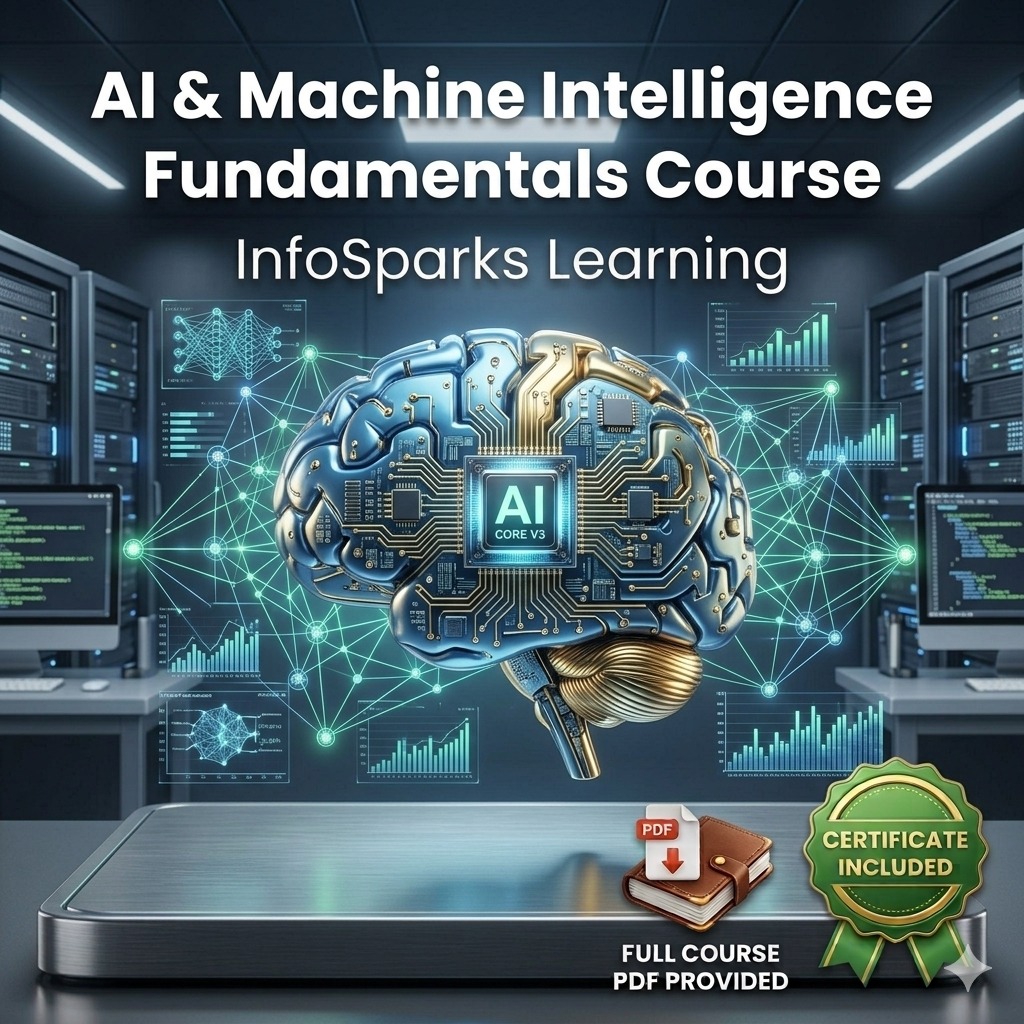
Build a clear foundation in Artificial Intelligence (AI) and Machine Intelligence (MI).
This self-paced fundamentals course introduces the concepts, methods, and practical uses behind intelligent systems. It is designed for beginners, students, professionals, and business users who want a structured starting point before moving to technical or advanced AI topics.
Course format:
• Self-paced digital course
• Beginner level
• Includes lessons, practical examples, and knowledge checks
Important: This product is a digital course. No physical shipment.
Build a clear foundation in Artificial Intelligence (AI) and Machine Intelligence (MI).
This self-paced fundamentals course introduces the concepts, methods, and practical uses behind intelligent systems. It is designed for beginners, students, professionals, and business users who want a structured starting point before moving to technical or advanced AI topics.
Full Course Syllabus
Module 1: AI Fundamentals & Engineering Basics
• The true definition of machine intelligence vs ordinary software automation.
• Paradigm shifts: The journey from rule-based AI to deep learning and Generative AI.
• The concentric architecture: Differentiating AI, Machine Learning, and Deep Learning.
• Crash course in Python syntax, dynamic typing, structures, and variables.
Module 2: Mathematics, Statistics & Data Preprocessing
• High-precision look at linear algebra: Tensors, scalars, vectors, and matrix multiplication.
• Statistical measures: Outlier treatment, mean, median, mode, variance, and standard deviation.
• Preprocessing pipelines: Data cleaning, imputation strategies, and label vs one-hot encoding.
• Scaling methodologies: Min-max normalization and standard z-score scaling without data leakage.
Module 3: AI Problem Solving, Search & Logic
• Classical state space graphing: Building search trees and avoiding cyclic loops.
• Uninformed vs informed search: BFS, DFS, Uniform Cost Search, and A* algorithms.
• Optimization heuristics: Hill climbing, simulated annealing, and bounded beam search.
• Adversarial mechanics: Minimax rules, alpha-beta pruning, and constraint satisfaction.
Module 4: Machine Learning Fundamentals
• The core ML workflow: Framing input features (\(x\)) to map accurately to target outputs (\(y\)).
• Mathematical modeling: Linear regression, error metrics (MAE, MSE, RMSE, \(R^{2}\)), and gradient descent.
• Classification parameters: Logistic regression, sigmoids, decision trees, random forests, and SVMs.
• Critical evaluations: Parsing confusion matrices, accuracy flaws, precision, recall, and F1-score.
Module 5: Unsupervised & Reinforcement Learning
• Unlabeled structures: Partitioning data using iterative K-Means and the elbow curve trick.
• Advanced clustering: Agglomerative hierarchy trees, DBSCAN density mapping, and PCA compression.
• Dynamic environments: Markov Decision Processes, Bellman equation setups, and reward values.
• Deep Q-Networks (DQN): Moving from discrete tabular Q-learning to high-dimensional neural spaces.
Module 6: Deep Learning & Neural Network Architectures
• Deep abstractions: Understanding artificial neurons, weighted matrix inputs, and bias tracking.
• Non-linear activation layers: When to use ReLU vs Sigmoid, Tanh, and Multi-class Softmax.
• Optimization flow: Multilayer Perceptrons (MLP), backward error propagation, and chain-rule calculus.
• Spatial & sequential networks: Computer vision CNNs, pooling matrices, RNN loops, LSTMs, and GRUs.
Module 7: Transformers & Modern Generative AI
• Attention mechanisms: Parallel self-attention arrays, key-query-value projections, and multi-head attention.
• Foundation modeling: Causal masking in GPT (generation) vs Bidirectional masking in BERT (understanding).
• Practical engineering: Prompt mechanics, few-shot structures, JSON outputs, and diffusion denoising.
• Modern stacks: Chunking parameters, tokenized embeddings, vector databases, and multi-agent loops.
Module 8: NLP & Computer Vision Engine Applications
• Human language text processing: Tokenization, crude stemming, dictionary lemmatization, and sentiment mapping.
• Translation & Speech: End-to-end neural acoustic spectrograms and sequence conversion.
• Vision structures: Semantic/instance pixel masking, spatial object detections, bounding boxes, and OCR.
Module 9: AI Visualization with Canvas & JavaScript
• Imperative drawing: Working with HTML5 Canvas 2D contexts, coordinate grids, and frame resolutions.
• Clean rendering loops: Utilizing requestAnimationFrame for battery-efficient, smooth simulation renders.
• Algorithmic plotting: Visually charting decision boundaries, K-Means clusters, and real-time search node paths.
🎯 Who Is This Course For?
• Software Developers who want to break into AI engineering by building projects from the ground up.
• Data Analysts looking to transition into predictive machine learning, deep learning, and advanced generative workflows.
• Computer Science Students needing a clear, code-first bridge connecting mathematical equations to functional programs.
Course Features
• Text-Based Learning: Focus deeply without video distractions. Our course is entirely content-based, allowing you to read, absorb, and learn at your own speed.
• Smart Progress Tracking: Never lose your place. Our intelligent “History Track” automatically saves your progress. If you read two modules today and come back two days later, your dashboard will show you exactly what you last read and suggest your next topic.
• Downloadable PDF Notes: Take your learning offline. Download full, beautifully formatted PDF versions of the course materials to study anytime, anywhere.
• Official Certificate: Earn recognition for your hard work. Receive a downloadable, verified Certificate of Completion as soon as you finish the final module.
• 100% Self-Paced: Study entirely on your own schedule. There are no deadlines, live classes, or expiration dates on your access.
How It Works
1. Read & Absorb: Log in and read through high-quality, text-based modules designed for deep comprehension.
2. Step Away Anytime: Close your browser whenever you need a break. Our system automatically bookmarks your exact location.
3. Pick Up Where You Left Off: When you return, check your personalized “History Track” to see your learning timeline and jump right into the next recommended topic.
4. Get Certified: Complete all the text modules, download your PDF notes for future reference, and claim your official certificate.
Shivani Arora –
Very Good